






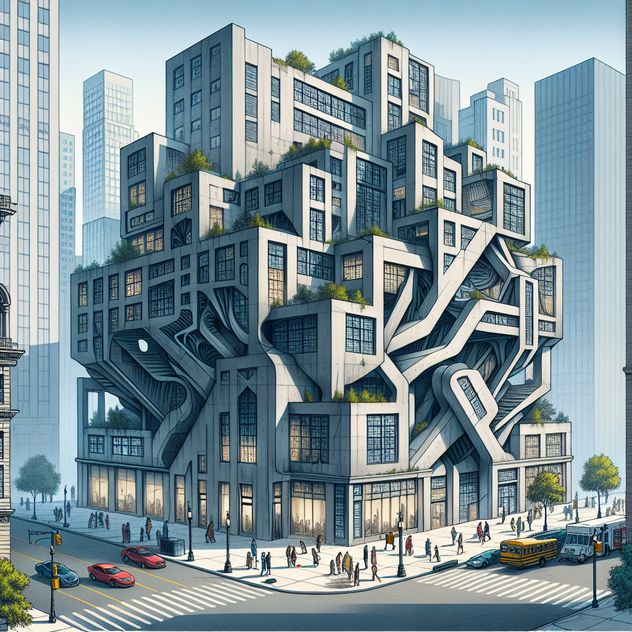
Growing up, I often passed by a gray, boxy structure at the corner of Melrose and Sycamore in Los Angeles, barely sparing it a glance. It looked more like a warehouse or a misplaced bunker than anything of value—a toothless presence among more lively facades. Like many locals, I unconsciously dismissed it as an architectural misfit, a leftover from a forgettable chapter in city planning.
It wasn’t until a recent revelation that my perception flipped on its head. That nondescript building—cold, windowless, and seemingly mute—was actually the work of none other than Frank Gehry, the architectural maestro behind the Walt Disney Concert Hall and countless other celebrated landmarks. The revelation was jarring. How could something I had mentally tossed into the bin of urban clutter be the creation of such a visionary?
Gehry’s work often thrives on dissonance, pushing back against conventional beauty and embracing oddity. Once I looked at the building through that lens, its language became clearer. The hard edges, the seemingly random exterior, and the unexpected choices all spoke to Gehry’s philosophy of challenging how we perceive space and form. Much like appreciating modern art, understanding buildings like this requires tuning into the frequency of intention over appearance.
This experience has made me reevaluate not just that one building, but the entire idea of value in urban architecture. Not every masterpiece demands your awe at first glance. Some whisper instead of shout. As residents and visitors, we’re often so conditioned to look for grandeur in clarity and symmetry that we miss the brilliance in restraint and mystery. Perhaps our cities are full of hidden treasures—we just haven’t learned how to see them yet.
In the end, my humbled perspective reminds me that beauty isn’t always obvious and genius sometimes hides in plain sight. That peculiar building from my childhood wasn’t a stain on the neighborhood—it was a seed of architectural rebellion quietly taking root. Frank Gehry saw something in that corner of LA that I didn’t, and now, decades later, I’m finally beginning to see it too.