







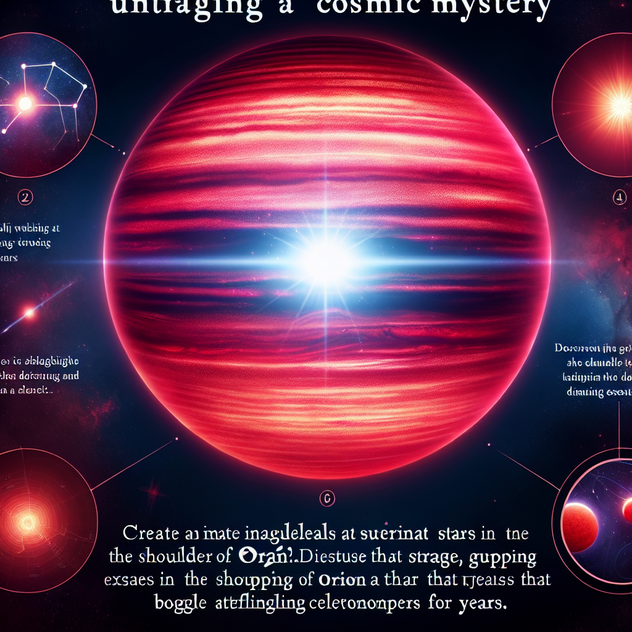
For years, astronomers have been captivated by Betelgeuse, the red supergiant star looming in the shoulder of Orion. Its strange dimming episodes and colossal size have made it a hot topic in the world of astronomy. Now, a new twist in the Betelgeuse saga has emerged — researchers using the iconic Hubble Space Telescope, along with ground-based observatories, have uncovered convincing evidence of a long-theorized but never-before-seen companion star orbiting this stellar behemoth.
This discovery comes not from direct observation of the companion itself, which remains invisible due to Betelgeuse’s overwhelming luminosity, but rather through a swirling ‘wake’ spotted in the gas surrounding the red giant. Much like a ship leaves ripples in its trail, this wake appears to be the gravitational fingerprint of a smaller companion star, subtly tugging on its supergiant neighbor. It’s a remarkable example of how modern astrophysics can reveal the unseen through its impact on the seen.
The implications of this discovery are far-reaching. Binary systems can dramatically influence the evolution of massive stars, particularly in how they lose mass — a key factor that determines how and when a star will go supernova. If Betelgeuse really does have a stellar sidekick, it could help explain some of the strange behavior astronomers have witnessed in recent years, including its historic dimming event in late 2019. The companion may be shaping Betelgeuse’s fate more profoundly than we ever imagined.
From a broader perspective, this finding underscores the importance of multi-instrument and multi-wavelength observations. Combining space- and ground-based telescopes creates a synergy that allows scientists to study cosmic giants like Betelgeuse in far greater detail. It also highlights how indirect measurements — such as interpreting wakes and disruptions in interstellar material — can lead to concrete discoveries about elusive celestial objects.
In the grand scheme of stellar evolution, uncovering a companion to one of the most studied stars in our sky brings new life to our understanding of how stars live and die. As astronomers continue to monitor Betelgeuse, now with a new player on the stellar stage, we stand on the edge of possibly predicting — and perhaps even witnessing — one of the most awe-inspiring events in the cosmos: a supernova from a star we’ve come to know intimately. Until then, Betelgeuse reminds us that the universe always has more secrets waiting just beneath the surface.