








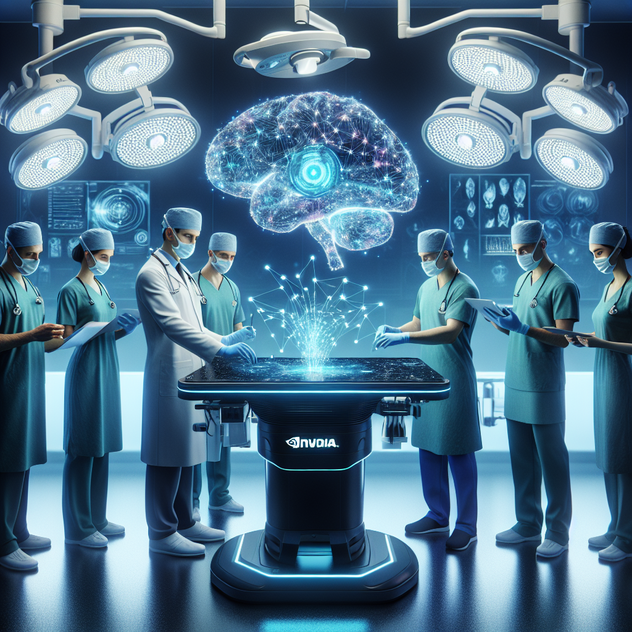
In the ever-evolving landscape of medical technology, XRlabs is taking a bold step forward by combining artificial intelligence with surgical precision. By leveraging NVIDIA’s Jetson Thor and Isaac for Healthcare platforms, the company is bringing a new dimension of intelligence to operating rooms. Their solution retrofits existing surgical tools with smart capabilities, creating a hybrid of physical instrumentation and digital brainpower. This is not just an upgrade in tech—it’s a reimagining of how surgeries are conducted in the age of automation and AI.
At the heart of XRlabs’ innovation lies real-time AI analysis, a feature that enables the surgical team to receive instant feedback during procedures. This can dramatically enhance situational awareness, potentially reducing errors and improving outcomes. Furthermore, the incorporation of vision-based tool tracking ensures that every movement of an instrument is accounted for, offering a detailed and dynamic overview of the procedure. The result is a highly responsive OR environment where insights are generated on the fly, augmenting human decision-making instead of replacing it.
What makes XRlabs’ approach especially clever is its ability to integrate with current surgical workflows instead of overhauling them. Hospitals and care centers can outfit their existing OR suites with this new layer of intelligent automation, sidestepping the cost and complexity of a full infrastructure change. As medical budgets become increasingly strained, this kind of modular upgrade is not only more feasible but far more scalable. It’s a win-win scenario for both practitioners and administrators aiming to modernize care delivery without turning their facilities upside down.
Still, it’s not just about efficiency and cost savings—intent-aware automation brings a philosophical shift in how we think about artificial intelligence in medicine. By designing systems that can infer the intention behind a surgeon’s movement or sequence of actions, XRlabs is nudging technology into more empathetic territory. When machines begin to understand ‘why’ as well as ‘what’ is happening in the OR, the possibilities for collaboration between human and machine become truly transformative. It signals a future where AI is not just smart, but insightfully supportive.
In conclusion, XRlabs’ integration of NVIDIA’s advanced tools into the operating room is a significant stride toward intelligent, adaptive healthcare. As this technology matures, we could see a new paradigm in surgery—one where machines enhance human capability without overshadowing it. The marriage of physical AI with surgical expertise may prove to be the next great leap in medical innovation, one that makes the operating room not just more advanced, but safer and more intuitive for all involved.